
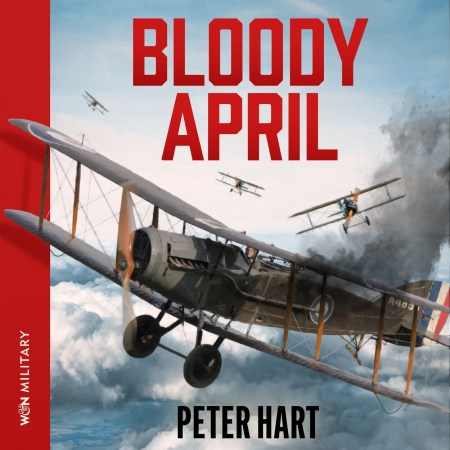
In Bloody April, military historian Peter Hart tells the vital story of the air war over Arras with eyewitness accounts from the men who were actually there.
As the Allies embarked upon the Battle of Arras in April 1917, they desperately needed accurate aerial reconnaissance photographs. But by this point in the First World War, pilots from the Royal Flying Club were flying obsolete planes. The new German Albatros fighters outclassed them in every respect: speed, armament, ability to withstand punishment and manoeuvrability. Many of the RFC’s pilots were straight out of flying school; as they took to the air, they were sitting targets for the experienced German aces.
Over the course of the air support operation that became known as ‘Bloody April’, the average life expectancy of a new subaltern on the front line dropped to just eleven days. And yet they carried on flying, day after day, in the knowledge that – in the eyes of their commanders at least – their own lives meant nothing compared to the photographs they brought back, photographs that could save tens of thousands of soldiers on the ground.
As the Allies embarked upon the Battle of Arras in April 1917, they desperately needed accurate aerial reconnaissance photographs. But by this point in the First World War, pilots from the Royal Flying Club were flying obsolete planes. The new German Albatros fighters outclassed them in every respect: speed, armament, ability to withstand punishment and manoeuvrability. Many of the RFC’s pilots were straight out of flying school; as they took to the air, they were sitting targets for the experienced German aces.
Over the course of the air support operation that became known as ‘Bloody April’, the average life expectancy of a new subaltern on the front line dropped to just eleven days. And yet they carried on flying, day after day, in the knowledge that – in the eyes of their commanders at least – their own lives meant nothing compared to the photographs they brought back, photographs that could save tens of thousands of soldiers on the ground.
Reviews
An intensely detailed work
Thanks to Peter Hart's skilful efforts, Francis Penny and his comrades are not distant historical figures. Their own words conjure a vivid reality, their characters come alive and their stories move us